
Every panchang tradition recognises a daily window that requires almost no calculation and carries no planetary affliction. Abhijit muhurat falls near the middle of the day, when the sun stands highest. It has been used for centuries when a formal muhurtham is unavailable or when an opportunity cannot wait.
The word abhijit means victorious. In the Mahabharata, Abhijit is the name of a nakshatra that once stood above the twenty-seven we use today. Though that constellation no longer appears in the standard panchang, the name was given to this midday period because it shares the quality of transcendence.
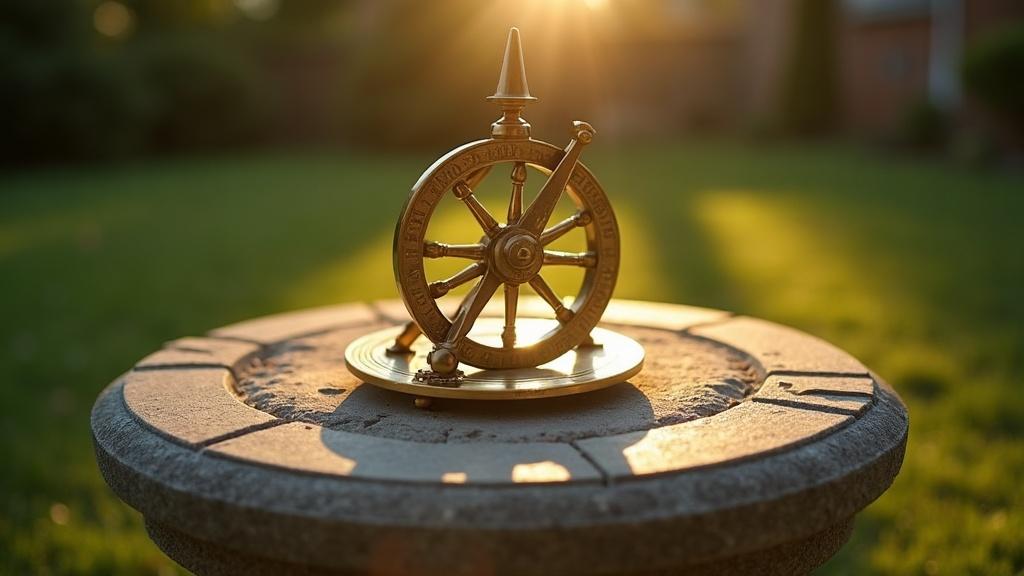 View full-size illustration ↗
When abhijit muhurat occurs
Abhijit muhurat begins eight ghatis before apparent noon and lasts for one ghati. A ghati is one-sixtieth of the time between sunrise and sunset, so the length varies slightly with the season and latitude. In practical terms, abhijit spans roughly 48 minutes centred on local solar noon, not clock noon.
To find it, calculate the midpoint between sunrise and sunset for your location on the day in question. Subtract 24 minutes and add 24 minutes. Most panchang services and the panchang page on this site list abhijit timing daily, already adjusted for your time zone and daylight saving.
Because it follows the sun rather than the clock, abhijit occurs at different times across the continent. In Vancouver it might fall at 1:15 PM Pacific in summer, while in Halifax it falls near 1:00 PM Atlantic on the same day.
What makes it auspicious
Classical texts describe abhijit as a kala, a period of time, that is shubha by nature. It does not depend on tithi, nakshatra, yoga or karana. The sun at its zenith is considered strongest, and the moment carries clarity.
This does not mean abhijit overrides every other consideration. It is a fallback, not a universal remedy. When a full muhurtham analysis on the muhurtham page is possible, that remains the preferred method. Abhijit is for the times when detailed electional work cannot be done: a signature needed today, an interview scheduled by someone else, a journey that must begin now.
Some regional traditions avoid abhijit on Wednesdays. Others exclude it during Chaturthi, Chaturdashi, Amavasya and certain nakshatras. The Nirnaya Sindhu and related digests list these exceptions, and they vary by school. A conservative approach is to check the full panchang before relying on abhijit for something important.
Common uses in daily life
| Purpose | Suitability | Notes |
|---|---|---|
| Starting a new job | Yes | First-day formalities, meeting the team |
| Signing documents | Yes | Contracts, leases, enrolment forms |
| Travel departure | Yes | Especially unplanned or rescheduled trips |
| Medical procedures | Conditional | Urgent care; elective surgery deserves fuller analysis |
| Marriage ceremony | No | Vivaha muhurtham requires detailed matching |
| Housewarming | No | Griha pravesh has its own structure |
Abhijit works well for beginnings that are modest in scale or constrained by circumstance. It does not replace the care taken for life events that permit planning.
 View full-size illustration ↗
How to observe it
No ritual preparation is required. If you are starting something during abhijit, begin the action within the window. For a document, place your signature. For a purchase, complete the payment. For a journey, step outside or start the vehicle.
Some families prefer to begin with a short prayer or a moment of silence. Others simply proceed. The muhurat itself does the work; your awareness of it is enough.
If you are far from India and the day feels out of step with the calendar back home, remember that abhijit follows the sun wherever you are. Local solar noon in Toronto is as valid as local solar noon in Chennai. The tradition adapts to the ground beneath your feet.
Limitations and exceptions
Abhijit does not remove a dosha in the birth chart, nor does it guarantee success. It offers a neutral or favourable starting condition, nothing more. If the action itself is poorly conceived, the timing will not rescue it.
Wednesdays are widely excluded, though not universally. Chaturthi and Chaturdashi tithis are also commonly avoided. Some authorities exclude Amavasya and Purnima. If you are consulting a family astrologer or pandit, ask which exceptions they follow. When in doubt, use abhijit only for small or unavoidable matters on those days.
Abhijit is not listed in every classical text, and scholars debate its antiquity. The Muhurta Chintamani describes it; the Brihat Samhita does not mention it by this name. Regional practice fills the gaps. This is normal in a tradition that has always adapted to local need.
Using abhijit from abroad
In North America, the midday window may fall during a work meeting or a school run. If you cannot act precisely within abhijit, do what you can in the hour surrounding it. The principle is to align intention with the sun's height, not to achieve the minute.
If you are coordinating with family in India, remember that their abhijit and yours occur at different clock times but the same solar moment in each place. A signature in New Jersey at 12:30 PM Eastern and a countersignature in Mumbai at 12:30 PM IST both fall near their respective solar noons, and that is enough.
The panchang page on this site calculates abhijit for your location automatically. Check it the night before if you expect to need it, and set a quiet reminder.
A practical grace
Abhijit muhurat is a gift of simplicity. It asks no elaborate preparation, no gems, no homa. It says that the sun itself, at its daily peak, is enough to bless a modest beginning. In a life lived far from temples and family astrologers, that is no small thing.