
Brahma muhurta appears in the Vedas and later texts as the last muhurta of the night, the period when Brahma, the creator, is said to be awake and the world is still. A muhurta is one-thirtieth of a day, or 48 minutes. The last muhurta before sunrise therefore begins roughly 96 minutes before the sun crosses the horizon, though some traditions define it as the full 90-minute window ending at dawn.
The concept is not mystical timekeeping but an observation about physiology and environment. The air is cool, sounds are few, and the mind has not yet engaged with the day's demands. In apartment buildings in Toronto or Edison, this may be the only quiet you will find.
 View full-size illustration ↗
Why This Time Is Different
The classical texts, including commentaries on the Atharvaveda, describe brahma muhurta as a period when sattva guna predominates. The body has completed most of its overnight repair, sleep pressure has lifted, and the mind is alert but not yet reactive. Modern sleep research identifies this as the tail end of the final REM cycle, when the brain is active but the stress hormone cortisol has not yet peaked.
No text promises that waking at this hour will bring success or health. What the tradition says is that if you are going to sit for meditation, recite a mantra, or study a shastra, this is the time when the least effort is required to keep the mind steady.
How to Calculate It for Your Location
Brahma muhurta is tied to sunrise, which varies by latitude, season and whether you follow drik (observational) or vakya (mean) panchang. In summer in Vancouver, sunrise may be at 5:15 AM; in winter, after 8:00 AM. The muhurta shifts accordingly.
The simplest method is to check a panchang for your city. Our Panchang page calculates sunrise for your coordinates and lists the muhurtas of the day. Subtract 96 minutes from local sunrise to find the start of the period, or use the 90-minute window if your tradition defines it that way. Daylight saving time does not change the astronomical event, only the clock you read.
If you are travelling or live where few pandits publish a local panchang, any accurate sunrise calculator will do. The US Naval Observatory and timeanddate.com are reliable. Brahma muhurta is not a ritual window that requires a priest's sanction; it is a fact of the sky.
What the Tradition Prescribes
The texts are specific about what to do and what to avoid. The Ashtanga Hridayam and other Ayurvedic works say to wake, eliminate, rinse the mouth and eyes, then sit. The mind is clear; this is the time for:
- +Meditation or pranayama
- +Recitation of a mantra or stotra
- +Study of a sacred text
- +Contemplation or sankalpa, setting an intention
- +Gentle movement such as yoga asana, done slowly
What is not recommended is heavy exercise, loud music, argument, or jumping immediately into work email. The point is to let the mind's natural stillness persist a little longer before the day's rajas takes over.
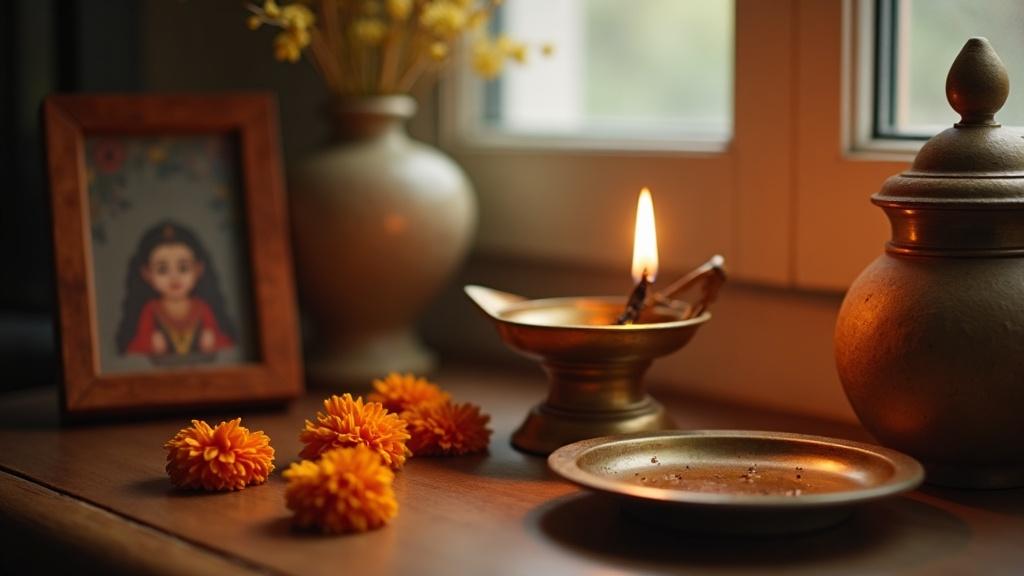
Some families also use this time for a brief puja or to light a lamp, particularly on Mondays or Thursdays. If you share a home with people on different schedules, even five minutes of seated stillness with a candle is enough.
 View full-size illustration ↗
The Difficulty of Keeping the Practice
In India, brahma muhurta aligns roughly with 4:30 to 6:00 AM year-round, and the culture accommodates it. In North America, the window moves dramatically with the season, and few employers or schools care whether you were awake at 3:45 AM in June.
The tradition does not say you must wake at this hour every day or that missing it is a fault. It says that if you can, the conditions are favourable. If you work a night shift, care for an infant, or have a sleep disorder, the instruction does not apply. The Dharma Shastras are clear that one's duty to health and family comes first.
If you do want to try, start with one or two mornings a week. Set a simple intention: sit for ten minutes, or read one page of the Gita. The habit matters more than the duration. Keep a shawl nearby; the body cools quickly when still.
Brahma Muhurta and the Panchang
Because brahma muhurta depends on sunrise, it is listed in most traditional panchangs under the heading of muhurtas or as part of the daily timetable. Our Panchang page calculates it automatically for your location and shows how it shifts through the year.
If you follow a daily practice, checking the panchang the night before helps you set an alarm that makes sense. In December in Chicago, brahma muhurta may begin at 5:30 AM; in June, at 3:00 AM. Knowing this prevents the frustration of trying to hold a fixed schedule against a moving target.
Some users also like to pair brahma muhurta with our Daily Darshan page, which offers a short reflection or shloka suited to the day's nakshatra. It is a way to anchor the quiet in something larger than your own discipline.
A Time, Not a Requirement
Brahma muhurta is an opportunity the sky offers every morning, not a test of your worthiness. If you wake and sit, the mind may be steady. If you sleep through, nothing is lost. The tradition is describing what is true about that hour, not prescribing a rule for all people at all times.
What matters is that when you do have the chance—on a weekend, during a retreat, or in a season when your schedule allows—you know what the window is, how to find it, and what to do with the stillness it offers.