
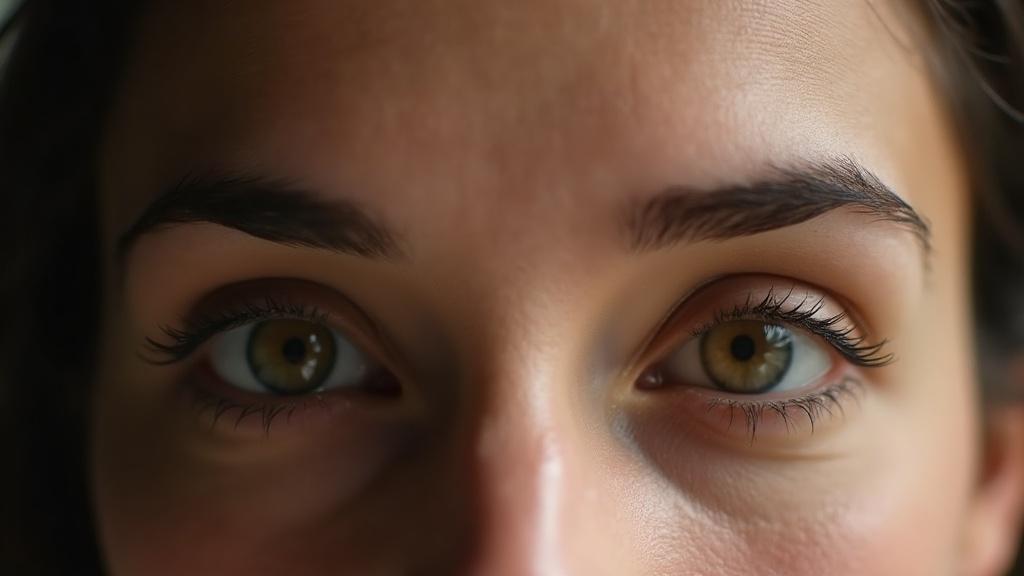
The eyes have been studied across cultures for what they reveal about a person's inner world. In Samudrika Shastra, the classical Indian tradition of physiognomy, the eyes are observed for their shape, placement, depth and movement. The practice does not claim to predict events but to read temperament, energy and the manner in which someone engages with their surroundings.
 View full-size illustration ↗
The Five Classical Eye Shapes
Samudrika texts describe eyes primarily by their outline and proportion. Almond eyes, slightly elongated with defined outer corners, are considered balanced and are associated with steadiness and discernment. Round eyes, more circular in appearance, suggest openness, curiosity and emotional responsiveness. Narrow eyes, where the visible iris is partly covered by the lids, point to focus, caution and deliberate thought. Deep-set eyes, recessed beneath the brow, are read as reflective and inward-turning. Protruding eyes, more prominent on the face, indicate outward energy and expressiveness.
These are tendencies, not fixed categories. A person may show traits from more than one type, and expression changes with mood, health and circumstance.
Placement and Spacing
The distance between the eyes and their position relative to the bridge of the nose also carry meaning. Wide-set eyes, where the gap is noticeably broad, suggest a person who takes in many perspectives and thinks in broad strokes. Close-set eyes indicate concentrated attention, intensity and a preference for depth over breadth. Eyes that sit high on the face are associated with idealism and aspiration, while those placed lower suggest practicality and groundedness.
In North American cities like Vancouver or Chicago, where apartment living and screen time dominate, these placements may also reflect how someone navigates crowded transit, open-plan offices or the need to hold multiple cultural frames at once.
Size, Depth and the Iris
Large eyes are traditionally read as receptive, empathetic and quick to register emotion. Smaller eyes point to selectivity, patience and the ability to sustain focus over long periods. The depth of the eye socket matters as well. Eyes set deep beneath the brow are said to belong to thinkers and those who process internally before speaking. Eyes that sit forward on the plane of the face suggest immediacy and a readiness to act.
The size and clarity of the iris, the steadiness of the gaze, and the frequency of blinking all add nuance. A steady gaze is associated with confidence and presence. Frequent blinking may indicate nervousness or an active, racing mind. The whites of the eyes, their colour and clarity, are also noted, though these change with rest, diet and overall health.
Common Eye Characteristics and Their Readings
| Feature | Traditional Reading |
|---|---|
| Almond shape | Balance, discernment, steady temperament |
| Round eyes | Openness, emotional responsiveness, curiosity |
| Narrow eyes | Focus, caution, deliberate thought |
| Wide-set | Broad perspective, idealism, inclusive thinking |
| Close-set | Intensity, depth, concentrated attention |
| Deep-set | Reflection, introversion, internal processing |
| Protruding | Expressiveness, outward energy, visibility |
 View full-size illustration ↗
What the Tradition Does Not Claim
Samudrika Shastra does not predict illness, misfortune or life events from eye shape. It does not claim that one type is superior to another. The texts describe patterns observed over generations, not fixed rules. A person with narrow eyes is not destined to be suspicious, nor is someone with large eyes guaranteed to be trusting. Context, upbringing, experience and choice all shape behaviour far more than bone structure or tissue.
If you are curious about how these observations fit within a fuller reading of your face or birth chart, the Free Kundli tool offers a starting point, and the Products page lists consultations that bring together multiple traditional frameworks.
Expression, Movement and Change
The way the eyes move, rest and respond matters as much as their static form. A gaze that meets others directly suggests confidence or challenge, depending on context. Eyes that look away frequently may indicate shyness, respect or simply a habit formed in a culture where direct eye contact is less common. Crow's feet, the lines that form at the outer corners, are read as signs of warmth, humour and a life lived in expression. Tension around the eyes, visible in the brow or lids, points to stress, fatigue or unresolved worry.
For families in the diaspora, where children grow up between two sets of norms, these small signals can shift between home and school, between the language spoken at the dinner table and the one used at work.
Working With What You See
If you notice patterns in your own eyes or those of someone close to you, treat the observation as information, not verdict. Eye shape face reading in the traditional sense is about recognizing tendencies so you can work with them. If your eyes are deep-set and you find yourself overthinking, build in time for external input. If they are wide-set and you struggle to finish projects, practice narrowing your focus to one task at a time. If they are round and you feel everything intensely, honour that sensitivity instead of trying to flatten it.
Nothing here replaces medical advice. If your eyes change suddenly in appearance, colour or comfort, see a doctor. The tradition observes what is stable, not what is symptomatic.