
Many families living in Toronto, Chicago or the Bay Area occupy apartments where a separate puja room is not an option. A studio or one-bedroom does not offer the luxury of dedicating an entire chamber to prayer. Vastu shastra, however, was written for householders of every circumstance, and the tradition recognizes that devotion matters more than square footage. What follows is practical guidance for arranging a sacred corner when that corner is all you have.
 View full-size illustration ↗
Choosing the corner
The northeast, called Ishanya, is the first choice. If the layout of your apartment places a bathroom, kitchen or storage closet there, the second choice is the east wall, and the third is the north. Avoid the southwest entirely; that zone is considered heavy and unsuitable for an altar. Avoid the southeast if possible, as it is associated with Agni and can create restlessness near a place of quiet.
Measure from the centre of your apartment or from the main entrance if the building plan is irregular. A compass app on your phone is accurate enough. If the northeast corner falls inside a bedroom, that is not ideal but it is workable; many families have no other option. In that case, keep the altar covered with a clean cloth when not in use, and do not store clothing or personal items on the same shelf.
The altar itself
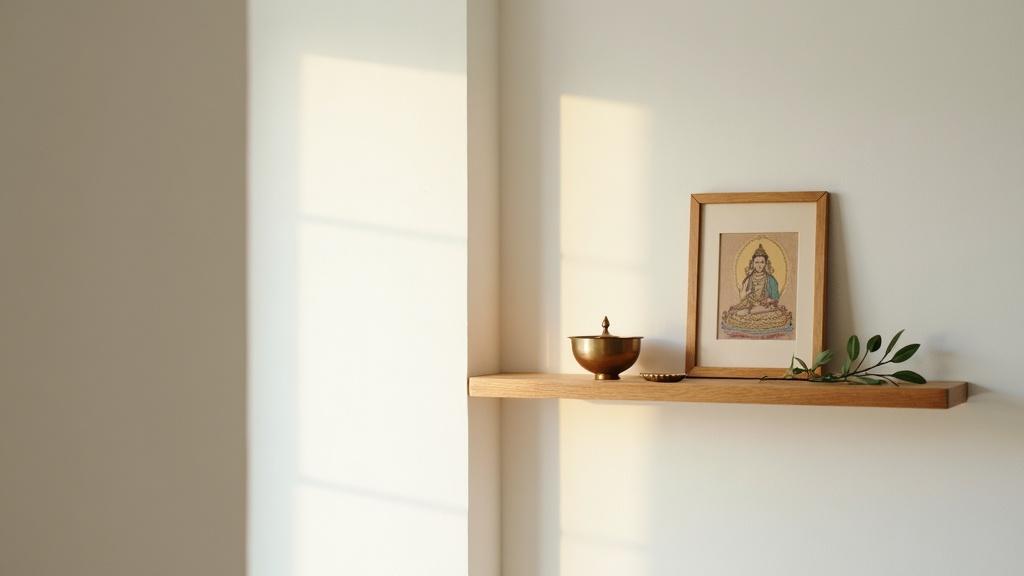
A small wooden shelf, a corner cabinet or a wall-mounted bracket will serve. The altar should be at chest height or slightly above, never on the floor. If you must use a low table, sit on a cushion so that your eyes meet the image at a comfortable angle. The wall behind the altar should be uncluttered. Do not hang photographs of deceased relatives there; those belong elsewhere in the home.
The surface should hold only what you use in daily worship: a diya or candle, an incense holder, a small bell, a water vessel if your practice includes abhisheka, and the murti or image. Rotate flowers and prasad daily if you offer them. Dust and disorder break the atmosphere faster than a small space ever could.
Orientation and seating
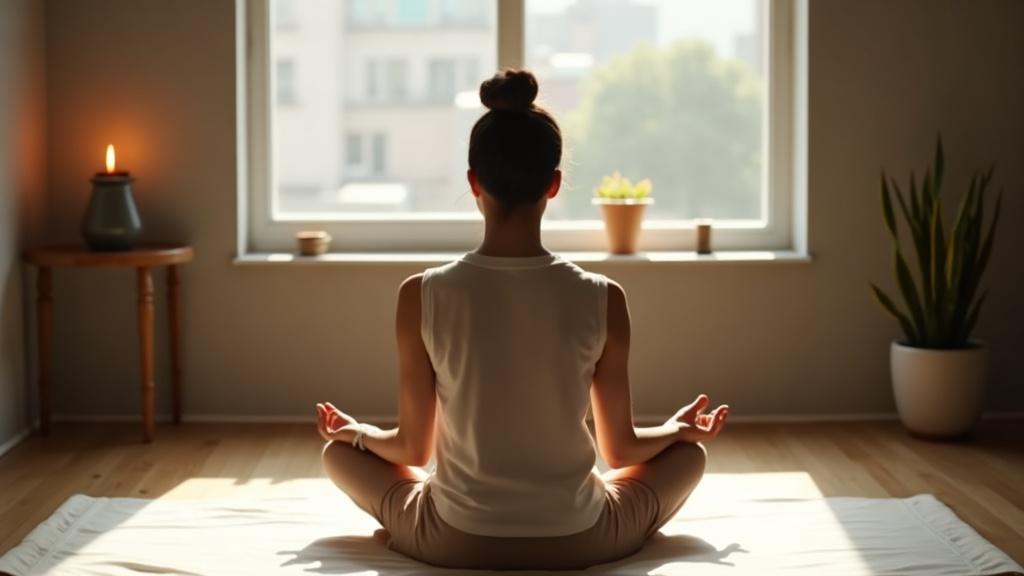
Face east or north while you pray. This may mean sitting with your back to the room, which feels awkward at first but becomes natural. A small cotton mat or silk cloth marks the spot and keeps the practice consistent. If the apartment is shared and others walk behind you during morning puja, that is simply the condition of apartment life; your focus is what matters.
Avoid placing the altar so that your feet point toward it when you sleep. If the bedroom is the only option and the bed cannot be moved, position the altar on the east or north wall rather than directly opposite the bed.
What vastu asks of a small space
| Principle | How it applies |
|---|---|
| Brahma sthana (centre) clear | Keep the centre of the room open; do not place the altar there |
| Northeast light and open | A window in that direction is excellent; if not, use a soft lamp |
| No overhead storage | Avoid shelves or cabinets directly above the altar |
| Clean wall behind | No pipes, electrical panels or clutter on the wall behind |
| Daily attention | Even five minutes of care sustains the space |
When the apartment itself is misaligned
Many buildings in North America are oriented to the street grid, not to the cardinal directions. Your apartment may face northwest or the entrance may open to the south. Vastu does not demand that you move. Instead, it asks that you work within the space you have. Identify the best corner relative to your front door, keep that area clean and well-lit, and do not let theoretical imperfection prevent actual practice.
Some teachers recommend remedies: a small mirror on the south wall, a bowl of sea salt changed weekly, a Vastu Purusha yantra under the threshold. These do no harm if they bring you peace, but they are not required. What is required is regularity. A corner tended every morning becomes sacred through your presence, not through its compass bearing.
 View full-size illustration ↗
Integrating the practice
The difficulty of keeping a daily rhythm in a one-bedroom is not the space but the hundred small interruptions: a roommate's schedule, a landlord's maintenance visit, the pressure to use every surface for something practical. Set a time, even if it is only ten minutes before work. The Daily Darshan page on this site can help you build that rhythm.
If you share the apartment with someone who does not pray, a simple conversation about the corner usually resolves any awkwardness. Most people respect a small, tidy altar once they understand it. If privacy is needed, a folding screen or a curtain on a tension rod will do.
A corner is enough
Vastu's deeper instruction is not about dimensions but about attention. A corner kept clean, a lamp lit at the same hour, a moment of stillness before the day scatters your mind—these are the things that make a home a place of practice. The Vastu section of this site covers broader principles, but the heart of the matter is this: the gods do not measure your apartment. They notice whether you remember them.
What you cannot do is less important than what you do. Light the lamp, say the prayer, and let that be sufficient.