
Your life is not a template
When someone opens a personalised report, they reasonably expect it to say something useful about them. A past-event section can feel like a direct test: the events have already happened, so the reader knows whether the account is right. That expectation makes the presentation especially important. An attractive document should never turn a broad sentence into the appearance of a verified biography. Your life deserves more care than a collection of statements that could apply to almost anyone.
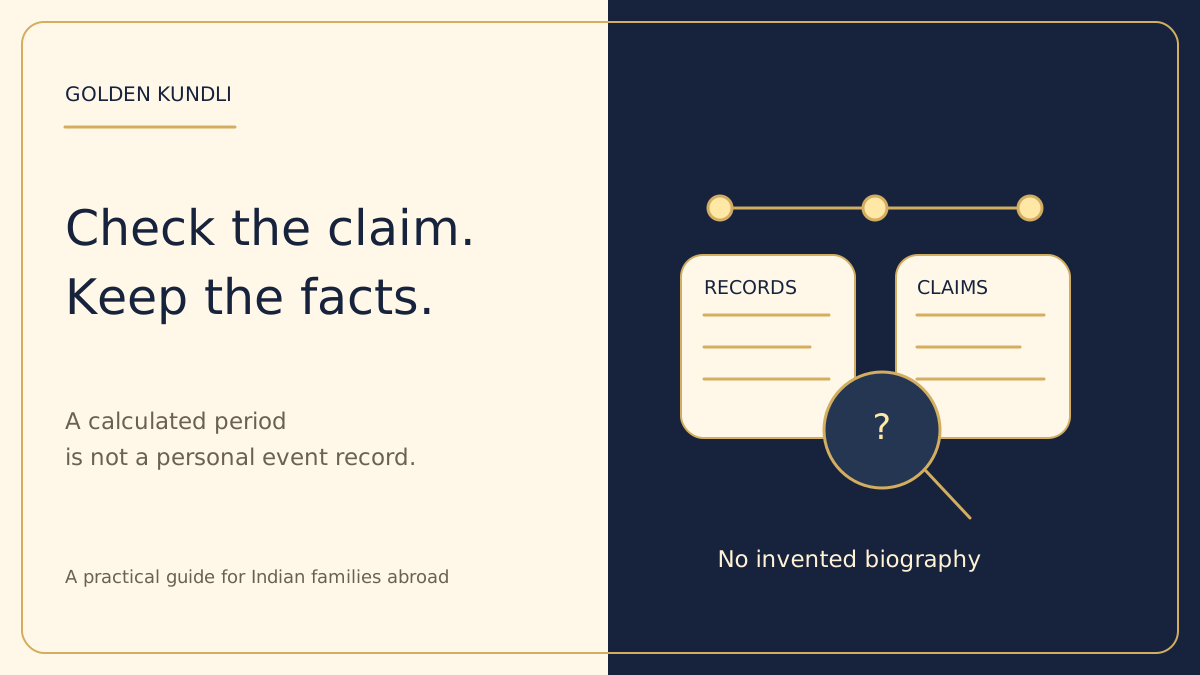
This guide offers a practical way to inspect a past-event report. It distinguishes information you supplied, outputs calculated within an astrological model and interpretations that have not been independently established as facts. It also explains how to record matches, misses and uncertainty without forcing your memories to fit the wording. The examples are invented for teaching the checking process. They are not claims about a real customer, a validated prediction method or results generated for your birth details.
 View full-size illustration ↗
Three different kinds of information
Start by placing each statement in one of three categories. First, there are supplied facts: your name, birth details and any events or concerns you told the service. Second, there are calculated outputs, such as a planetary position or a period returned by a named calculation method. Third, there are interpretations: explanations that connect those outputs to themes or possible experiences. A report should not quietly move a statement from the third category into the first.
For example, if you tell a chat that you changed jobs in 2019 and the report later says you changed jobs in 2019, the sentence may be correctly repeating your information. It has not demonstrated independent knowledge of your past. If the report gives a period date from a calculation, that may be inspectable as a model output. It still does not prove that a job change, illness, marriage or move occurred during that period. These distinctions are the foundation of honest personalisation.
| Statement type | What it means | What it does not establish |
|---|---|---|
| Supplied fact | Information entered by you or a permitted helper | Independent discovery by the service |
| Calculated output | A result within stated inputs and conventions | A specific event in your biography |
| Traditional interpretation | A meaning proposed within a tradition | A guaranteed fact or outcome |
| Practical suggestion | A possible question or action to consider | Professional advice or a necessary remedy |
A period table is not an event record
Astrological reports may include Dasha periods. The AstrologyAPI Maha Vimshottari Dasha reference describes an output of periods with names and date boundaries. That is documentation of a model's output. It is not a record of what happened in an individual's life. A report should explain the traditional meaning separately and preserve the distinction between an interval and a demonstrated event.
If you see a date range beside the word 'career', ask what the statement is claiming. Is it suggesting a theme for reflection, asserting that an event happened or summarising an event you already entered? Those are different services. A trustworthy explanation should let you identify which one you are reading. If the provider cannot support a specific historical calculation, the report should say that rather than invent dates. Lack of available data is a limitation to disclose, not a blank space to fill with persuasive language.
Explore the idea · at your pace
A fair way to check a past-event claim
Choose any step below. Motion is optional; every explanation stays readable.
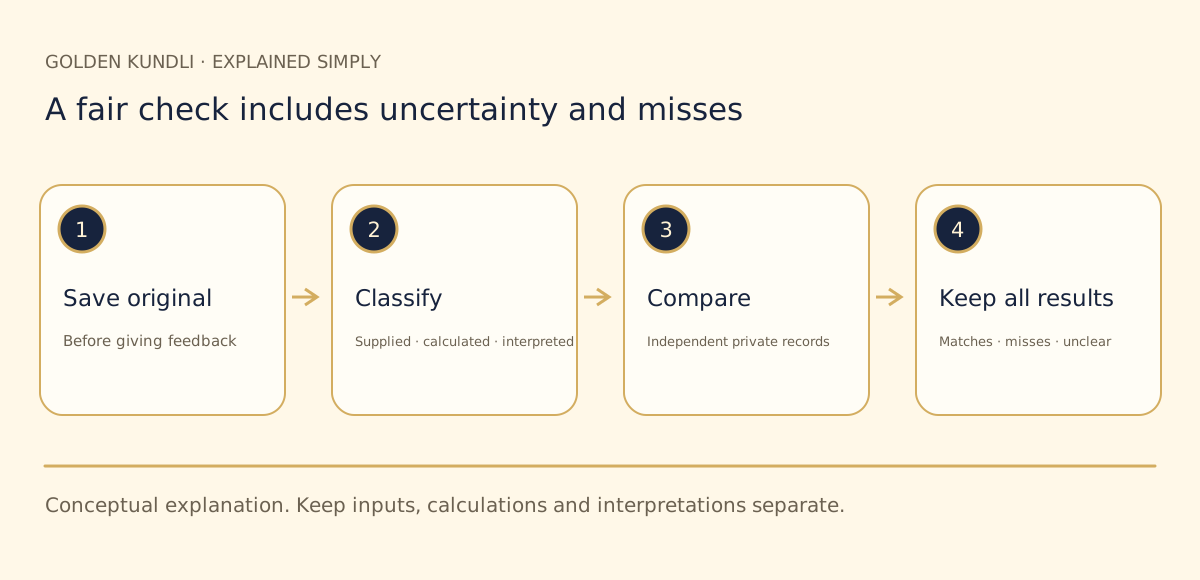
1. Save the original
Keep the unchanged report before giving feedback, together with its issue date and input summary.
2. Classify the claim
Was it supplied by you, calculated within a model or interpreted? These are not equivalent discoveries.
3. Compare records
Use independent information and definitions chosen beforehand. You do not need to upload sensitive documents.
4. Keep every result
Retain matches, misses and unclear statements together. A personal checklist does not establish a general accuracy percentage.
Your device prefers reduced motion. You can still choose every step above.
What makes a statement testable?
A testable statement has a reasonably clear meaning and time boundary. 'You have faced challenges' is too broad to distinguish one person's history from another's. 'A major change happened sometime in your early adult life' leaves so much room that a reader may attach it to several unrelated experiences. Before counting a match, ask whether the statement would have been identifiable without searching your memory for something that could fit.
This does not mean every useful reflective sentence must be a prediction. A guide may ask helpful questions without making factual claims about your past. The problem arises when a reflection is sold or presented as a specific discovery. A report can be warm, relevant and honest at the same time. It should label a general reflection as general, a contextual explanation as based on supplied information and an unverified interpretation as unverified. Clear labels make the content more useful, not less meaningful.
Keep the original before giving feedback
Save an unchanged copy of the report before discussing whether it feels accurate. Keep its issue date and input summary with it. If the service later revises the report, retain both versions and record why the change occurred. This allows you to distinguish a correction of an input error from an interpretation rewritten after hearing your story. Without the original, a conversation can gradually make the output appear more precise than it was.
You do not need to publish the document or send it to strangers. Store it privately and use only the details necessary for your own evaluation. If you cannot download a copy, take notes about the claims and their wording before providing feedback. A responsible service should not discourage you from recording what it originally said. If it changes a conclusion, the change should be understandable and dated rather than silently replacing the old account.
Build a small private timeline
Choose a few events that you can identify reasonably well. These might be the year of a move, the start of a job, a graduation or another non-sensitive milestone you want to use. Write the dates as precisely as your records allow. If you remember only the year, say so. Do not invent a month to make the timeline look complete. A good evaluation keeps uncertainty in the records as well as in the report.
Use documents you already control if they help your memory, but there is no need to upload passports, medical records, financial statements or family messages to an astrology chat. The purpose is to compare claims privately, not to create a new archive of sensitive information. When another person's event is involved, consider their privacy too. A timeline can remain on your own device or on paper. The report does not need access to every supporting document to be checked honestly.
Choose the checking rules before reading for matches
Decide what would count as a match, a miss or an unclear statement before comparing the report with your timeline. For an event recorded only by year, a month-specific claim cannot be verified from that record alone. For a broad claim such as a change in responsibilities, define which kinds of change you are willing to count. Otherwise the meaning may expand after the result is known.
This is a practical checking habit, not a validated scientific scoring system. Its value is consistency. You avoid accepting a narrow meaning for a sentence when it seems correct and a broad meaning when it seems wrong. If the statement remains too vague to classify, keep it in an 'unclear' column. Do not remove it from view or automatically count it as correct. The full record, including ambiguity, is more informative than a flattering summary of selected matches.
Count misses as carefully as matches
It is natural to remember a sentence that feels striking. It is equally important to notice claims that do not fit. If a report contains twenty statements and two seem impressive, the other eighteen still matter. A fair reading does not turn two memorable matches into proof that the entire report is reliable. Keep every claim in the list, including those that were irrelevant, wrong or impossible to check.
You can use a simple table with columns for the original sentence, its type, the date range, the evidence available and your classification. Do not convert that table into an advertised accuracy percentage. A personal check with a small set of selected events cannot establish a general success rate. It can help you decide whether the report was clear, whether its personalisation was genuine and whether the service handled limitations honestly.
 View full-size illustration ↗
A fictional comparison: precise, vague and supplied
Imagine Meera, a fictional reader, making a private timeline before reviewing a report. She has a record of a move in one year and a job change in another. One sentence mentions a specific move within a defined interval. Another says she has experienced disappointment. A third repeats a job change she described in the chat. These sentences should not be treated as three equivalent independent discoveries.
Meera checks the first against her record and the stated interval. She marks the second as too broad to evaluate reliably. She marks the third as supplied information. No actual dates or chart outputs are included in this example because the lesson is classification, not a fabricated demonstration of predictive power. Her final notes may say that one statement was testable, one was vague and one was contextual. That is more useful than saying the report 'knew everything' because some wording felt familiar.
Do not stretch memories to rescue a claim
Suppose a report describes a relocation, but you remember only a short holiday. Before treating that as a match, return to the original wording. Did it actually include temporary travel, or are you expanding the meaning because you want the result to fit? The same question applies to phrases about relationships, work and family. If almost any ordinary experience can count, the statement offers little evidence of specific knowledge.
You can still find a reflection meaningful without calling it a verified prediction. A sentence might encourage you to think about a transition or a pattern in your choices. That is a different kind of value. Keeping the distinction avoids two extremes: accepting every claim as fact or deciding that a reflective prompt has no use at all. Honest evaluation asks what the sentence can support, not how strongly the reader wants it to be right.
Separate input corrections from story fitting
If the report used the wrong person, wrong birthplace or mistaken time, correct the input and regenerate it. That is an ordinary quality issue. The provider should explain the correction and identify the new version. You should not be asked to reinterpret the old result as a hidden truth about someone else. A wrong subject is a wrong subject, regardless of the design of the PDF.
By contrast, if the service changes its interpretation only after you reveal an event, record that the new explanation uses your feedback. It may become more personally relevant, but that does not make it an independent prediction. A useful system can incorporate context openly: 'You told us this event occurred; here is a reflective discussion.' It should not say or imply that it had discovered the same event before you supplied it. This principle applies equally to a human-written report and an AI-assisted one.
Birth-time uncertainty limits confident detail
When the birth time is uncertain, the report should preserve that uncertainty throughout. It should not acknowledge a broad range on the input page and then deliver highly specific claims without explaining their dependence on the assumed time. Ask what was calculated, which time was used and which sections could change if the input changes. The unknown birth-time guide provides a practical starting point.
Do not treat a time adjustment that makes known events fit as proof that the resulting time is correct. Fitting a model to supplied history is different from checking it against information that was not used in the adjustment. Any proposed rectification method should state its assumptions and uncertainty. If the original record remains unavailable, the honest status may still be uncertain. An exact-looking clock value cannot create certainty by itself.
AI can explain, but it must not invent
A language model can organise a report, translate technical language into simpler words and help a reader compare supplied information. It can also produce a fluent story that sounds plausible while being unsupported. The quality of the prose does not establish the truth of the events. A system should prevent an explanatory model from inventing dates, diagnoses, relationship histories or personal milestones that are not present in verified inputs.
A responsible report process needs visible boundaries. Numerical outputs should come from a documented calculation source, not be guessed to complete a paragraph. Personal facts should be attributed to the user or another permitted source. Interpretations should be labelled and should not be upgraded into certain claims by confident wording. If a necessary calculation is missing, the correct response is to disclose the missing capability. It is not to substitute a convincing story and hope the reader will accept it.
More expensive data does not prove a biography
An external calculation provider may improve coverage, consistency or access to particular chart methods. That is useful when the product needs those calculations. However, buying an API package does not by itself validate claims about a person's past or future. There are still separate questions about correct inputs, correct implementation, interpretation quality and evidence for event claims.
When evaluating a service, ask which improvement is being offered. Is it a supported calculation that was previously unavailable? A clearer explanation? A better-organised PDF? A reviewed interpretation? Each can have value, but they should not be described as equivalent to verified life-event accuracy. The D1 and D9 guide also explains why additional chart types require correct labels and conventions rather than a promise that more diagrams always produce more certainty.
A report-quality checklist that does not pretend to be science
You can inspect a report using five plain questions. Is the subject correct? Are the inputs and uncertainty visible? Are numerical outputs attributed to a method? Are interpretations separated from established facts? Are the explanations specific enough to understand and fair about their limits? These questions evaluate transparency and usability. They do not produce a validated percentage for predicting life events.
Add a sixth question if the report is paid: did you receive everything advertised within the current scope? Check the contents, download access, support route and any stated storage period. A customer should not need to accept exaggerated claims to receive a complete product. Nor should a free preview be intentionally empty. A good preview demonstrates the explanation style and supported personalisation before purchase, while the full edition adds clearly described depth rather than claiming to unlock certainty.
Keep emotional and practical decisions separate
A past-event report may bring up grief, regret or unresolved questions. Read at a pace that feels comfortable. You do not have to share intimate details with a chat to receive a clear explanation of what the service can and cannot do. If a sentence causes distress, pause and consider talking with someone you trust or an appropriately qualified professional. A report should not use vulnerability as a reason to sell an urgent remedy.
Do not use an astrological account as the sole basis for a health, financial, legal or relationship decision. Relevant records, direct conversations and qualified advice remain important. Reflection may help organise questions, but it cannot replace evidence. A supportive service leaves room for the reader to disagree, correct an input, stop reading or choose not to purchase. There should be no suggestion that paying is necessary to prevent a disaster described by an unverified interpretation.
Help older family members check without pressure
If you are helping a parent or relative read a report on a phone, begin with the input summary and a single short section. Explain unfamiliar terms in ordinary language. Avoid presenting a large chart or date table as self-explanatory. Ask whether the reader wants to continue, and give them time to decide how much personal history they want to discuss. Assistance should increase their control, not remove it.
A paper checklist may be easier than switching between several screens. Write 'supplied', 'calculated' or 'interpreted' next to a few statements together. If a family member says a sentence is wrong, record that without arguing that the chart must somehow be right. If they find a reflection comforting, respect that while keeping factual claims distinct. This balanced approach makes the conversation more humane and more accurate.
What Golden Kundli should make clear
A useful Granth should identify its subject, show the information used and explain its supported calculations. If the customer entered a concern, the report can respond to that concern openly. It should not imply that the concern was independently discovered. When a section is a traditional interpretation, it should say so in language that remains visible in the downloaded PDF, not only in a small website footer.
Read the current accuracy explanation, privacy information and product contents before submitting details. Check availability instead of assuming every advertised future feature is active today. For a preview, look for substance you can understand and verify within the stated scope. For a paid report, expect the promised depth and a working download, while remembering that purchase does not transform an interpretation into a guaranteed fact.
A better standard than a dramatic claim
The most useful question is not whether a report sounds astonishing. It is whether it helps you understand what is known, what was calculated, what is interpreted and what remains uncertain. Preserve the original, use independent records where available and count every claim rather than only the memorable ones. These habits protect the reader from confusing a persuasive narrative with demonstrated knowledge.
Your past is real, specific and often complicated. It should not be flattened into a story that fits everyone or rewritten to match whatever you tell the service next. A personalised guide can offer organised reflection and explained calculations without pretending to know events it cannot verify. That is the standard worth asking for: clear inputs, clear methods, meaningful explanations and honest boundaries. Good design should make those boundaries easier to see, not hide them behind a premium appearance.