
Why the family calendar sometimes disagrees
One relative forwards a festival poster from India. Another sends the schedule of a Canadian temple. A third checks an app and finds a different date. Suddenly a simple family plan becomes a debate about which calendar is correct. For people living abroad, this is a common source of confusion. The first useful question is not 'Which person is wrong?' It is 'What location, local date and observance rule does each calendar describe?' Without those details, the two entries may not be answering the same question.
This guide helps you read a Panchang more confidently and organise a respectful family plan. It does not announce festival dates for a specific year, prescribe a religious rule or replace your temple's guidance. Its purpose is to make the moving parts understandable. Once you can separate a calculated interval from the way a community observes it, disagreements become easier to discuss. You can preserve a family tradition while still checking that the timing on your phone actually refers to the place where you live.
 View full-size illustration ↗
What a Panchang is for
A Panchang is a traditional calendar reference used to organise days and observances. Common entries include tithi, weekday, nakshatra, yoga and karana, alongside other timings depending on the publication. The India Meteorological Department's Rashtriya Panchang description identifies astronomical calendar data, rise and set timings, and festival information within its publication. That establishes the role of calculated calendar information; it does not mean every community uses an identical observance rule for every occasion.
For a beginner, think of the page as a collection of labelled intervals and reference times. Read the location and date at the top first. Then identify the entry you actually need. If you want to attend a temple event, its published event schedule may be the immediate practical reference. If you want to understand a tithi boundary, look for the time at which the entry begins or ends and the zone in which that time is displayed. Do not treat every number on the page as a personal prediction.
Tithi and civil day are different concepts
In the usual angular definition, a tithi corresponds to a 12-degree interval of the Moon's longitude relative to the Sun, normalised around a full circle. A civil date is the date on your local clock. These are different categories. For an arithmetic-only illustration, a relative longitude of 125 degrees lies in the eleventh 12-degree interval because 120 is the start of that interval. This example is not a calculation for today, a particular city or a real festival; it simply explains the division.
Because the angular separation changes over time rather than following your midnight boundary, a tithi need not begin at midnight or last exactly 24 hours. A calendar can therefore display a tithi that ends during a civil day. When you see an ending time, read the full label instead of assuming it is the start of an observance. If an app says 'until 10:30', ask 10:30 in which time zone and on which date. A clear interface should not make you infer those details from a decorative moon icon.
The Moon phase picture is not an observance rule
NASA's Moon-phase explanation describes the changing illuminated appearance of the Moon as it moves through its cycle. This is useful astronomical background. A picture of a waxing Moon, however, is not sufficient to decide a festival or vrat date. Observance decisions may depend on a specific traditional interval at a specified local reference time. A visually appealing phase graphic should help explain a concept, not pretend to replace a complete calendar calculation.
When a social-media card shows only a Moon picture and a date, treat it as a prompt to check the underlying calendar. Look for the city, year, tradition and source. An image can remain in circulation long after the event it originally described. If those labels are missing, do not forward it as authoritative timing. Share the source page instead and add a short note: 'Please check your local temple schedule.' This keeps the message useful without turning a decorative graphic into an instruction everyone is expected to follow.
Why local sunrise matters
Some calendar and observance rules use local sunrise as a reference. Sunrise itself depends on location and a stated computational convention. The US Naval Observatory's definitions explain that conventional sunrise involves the Sun's upper edge at the horizon, with assumptions about refraction and terrain. The actual view from a window can be affected by buildings or hills. A published sunrise time is therefore a defined reference, not a promise that you will see sunlight at exactly that second from every spot in the city.
For a reader abroad, the practical point is to keep the reference location consistent. A Panchang prepared for Delhi is not automatically a sunrise-based calendar for Calgary. Changing only the displayed time zone may not change the original calculation location or observance rule. If a calendar offers a city selector, verify that it recalculates or clearly documents what changes. If it only converts the display of an existing instant, that should be stated. A responsible explanation distinguishes these operations rather than calling every converted page a fully local calendar.
Explore the idea · at your pace
Why a local observance needs more than a clock conversion
Choose any step below. Motion is optional; every explanation stays readable.
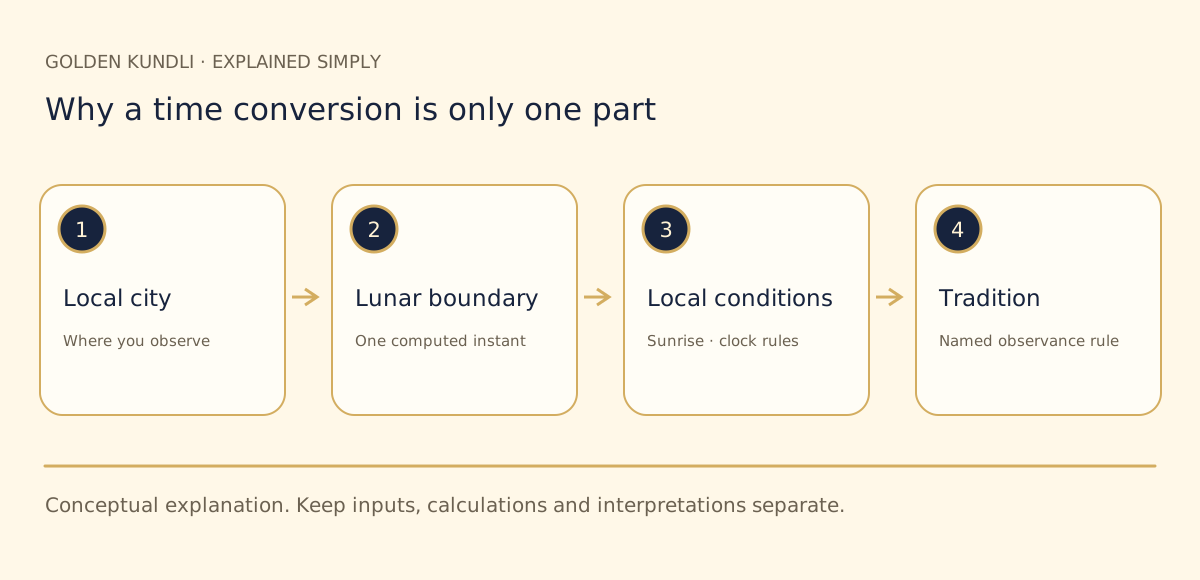
1. Choose the city
Use the place where the observance will happen, not automatically the birthplace or an Indian reference city.
2. Identify the instant
A computed lunar boundary is an instant. Its displayed clock time depends on the local time zone.
3. Check the local day
Sunrise and other local astronomical conditions may matter to the observance rule being used.
4. Name the tradition
The calendar should state the relevant rule and tradition. A converted time alone cannot settle every festival date.
Your device prefers reduced motion. You can still choose every step above.
Convert instants, not rules, with time zones
A time-zone conversion answers 'What does the clock show here at the same instant?' It does not automatically answer 'Which day should this community observe a festival?' That second question may require additional local references and a chosen tradition. The IANA database documents civil-time rules and their changes. Use the date-specific rules for the locations involved. Do not assume that a fixed number of hours describes the relationship between two cities throughout the year.
As a fictional planning example, imagine an announcement specifies an online lecture at a particular Indian clock time. Converting that event time into your local clock can be the right task. Now imagine an announcement says a vrat is observed according to a tithi at local sunrise. Copying the Indian civil date is a different task and may not be sufficient. The same family may legitimately use a converted time for an online session and a locally established date for an observance. Explain which task you are doing before comparing the results.
Read the location box before the main date
Check the selected country, state or province, city and time-zone label. If you recently travelled, make sure the app is not still using your home location. If you are planning a family event in another city, select that destination rather than your phone's current location. A family living across Calgary, Toronto and London should not assume that a single screenshot supplies everyone's local details. Keep each person's practical schedule separate while sharing the underlying explanation of the occasion.
City names can be ambiguous, and a familiar-looking choice may refer to a different country. Review the full place name before saving. When a calendar does not offer your location, avoid silently selecting a distant city and presenting it as exact. Ask what fallback is appropriate and how much the relevant timing might depend on location. The answer should be specific to the requested calculation, not a blanket reassurance. If the service cannot provide verified local observance data, it should say so clearly and direct you to a trusted local schedule.
Different traditions deserve clear labels
Family and temple traditions can differ in how they select an observance date. The useful response is to name the rule followed, not declare one community's practice universally correct without qualification. This article does not attempt to resolve every regional or sectarian rule. If an occasion is important to your family, ask the temple or knowledgeable adviser you follow which calendar and local reference it uses. Keep the answer with the event note so that relatives understand the basis of the plan.
You can say, 'For our household we are following this temple's local schedule,' without saying, 'Everyone who observes another day is wrong.' That wording respects both clarity and diversity. If the app offers only one tradition, its interface should not imply that it covers every practice. If a date has not been reviewed for your location and tradition, label it as information requiring confirmation. For community sharing, include a visible source line. The objective is an understandable plan, not an argument about devotion based on an unlabelled screenshot.
A practical weekly planning routine
Choose one short planning session each week. Review the next few days in your local calendar and identify the occasions your household actually observes. Write down the local date, any relevant timing, the selected location and the schedule source. Decide whether you need to attend a temple event, prepare a simple home observance, join an online gathering or just read about the occasion. These are practical decisions that do not require interpreting every calendar field at once.
Avoid setting many overlapping reminders before you know what they mean. A single reminder with a clear label is more helpful than a stream of unexplained alerts. Write 'Check temple schedule for Friday' rather than 'Critical planetary deadline'. Give yourself room to adjust for travel, accessibility and family responsibilities. If the plan changes, update the shared note rather than leaving contradictory messages in the group. A calm routine should make the week easier to organise. It should not create pressure to treat every notification as an urgent spiritual obligation.
Fasting information must not become medical advice
A calendar can tell you about an observance, but it cannot determine whether a particular fast is safe for your health, medicines or circumstances. If fasting could affect you, seek qualified health guidance and discuss an appropriate approach with the religious adviser you follow. This article provides no personalised fasting prescription. Do not stop medicines, ignore symptoms or change treatment because a calendar entry or chat response describes a traditional practice. Religious meaning and medical suitability are separate questions.
For family communication, avoid judging a person's devotion by whether they follow the same dietary practice. Someone may participate through prayer, reading, service or another approach consistent with their circumstances and tradition. If you are arranging a shared event, ask what practical accommodations people need without demanding private medical details in a group. A helpful app should describe the occasion respectfully and leave room for informed choices. It should never use fear of consequences to pressure a reader into an observance or a purchase.
 View full-size illustration ↗
Sharing a useful festival card
A well-labelled card should include the occasion, the location it refers to, the local civil date, the year and a source link. If the relevant tradition needs a label, include it. Keep the main message short enough to read on a phone, and place detailed timings on the linked page. Do not squeeze several unfamiliar abbreviations into tiny text just to make the card look comprehensive. The recipient should be able to understand what to check next without opening a paid report.
If the card is a devotional reflection rather than verified timing guidance, say so. For example, 'A reflection for this season' is different from 'The exact local observance time'. Do not blend those categories. A family can share a beautiful message while still using a separate authoritative schedule. Ask permission before posting promotional material in a temple or community group. Do not imply a temple endorses Golden Kundli simply because its members share a general educational link. Clear attribution protects both the reader and the community hosting the discussion.
What to do when two sources disagree
Make a small comparison table before asking for help. Include the city, time zone, year, date, interval label and any stated observance tradition for each source. Many apparent contradictions become easier to understand once one page is found to describe India and the other a local city abroad. If both claim the same scope but still disagree, ask for their calculation inputs and rule explanation. Avoid declaring a winner based on which design looks more premium or which result matches a forwarded message.
Keep a copy of the conflicting labels, but do not share unrelated profile information. A focused support question might say: 'These two pages both state Calgary for this date, but list different ending times; what method is used?' That gives the provider something concrete to investigate. If the disagreement concerns a religious observance rule, a technical support team may need to refer you to an appropriate tradition-specific authority. It is reasonable for an app to know its limits. An explanation is more valuable than a confident answer that ignores the question's actual scope.
Travel and family events need a separate check
If you travel between countries, decide whether the information is for your current location or the place where the event will take place. A departure airport, arrival city and home city can all have different clock dates at the same instant. Record travel plans separately from observance plans. Do not rely on an old downloaded calendar to update itself automatically. Before an important occasion, reopen the source and verify the location and date labels. This is especially useful when a family member is reading a printed copy.
For a wedding, housewarming or community gathering, practical arrangements also matter: venue availability, travel, weather, accessibility and the people attending. This guide does not promise that a traditional timing guarantees an outcome. Treat cultural timing as one input into a broader plan rather than a substitute for necessary preparations. If a report recommends a window, ask what calculation and tradition it uses and whether the requested feature is actually available. Do not pay for a feature labelled as a future release expecting it to produce a verified result immediately.
A phone-friendly way to help older relatives
When helping a parent read a calendar, show one occasion at a time. Start with 'This page is for Calgary' and 'This is the date shown on our local clock'. Explain an unfamiliar word with one short sentence before adding the detailed timing. Use the app's text-size or accessibility options if available, but do not assume a tiny screenshot will become readable when forwarded. Share a public link that they can open and enlarge, or write a short plain-language summary alongside it.
Ask the person to repeat what they plan to do, not to prove they have understood the vocabulary but to identify practical confusion. They may be asking about when to leave for the temple, while you are explaining a tithi boundary. Answer the actual question first. Keep the detailed explanation available for anyone who wants it. This style of handholding is respectful because it reduces unnecessary work without hiding information. A useful calendar helps a person participate; it does not require them to master a technical glossary before feeling welcome.
Use public tools without overstating their scope
Explore the Panchang page and vrat and festival calendar, checking the displayed location and any scope notes. Read our NRI guides for related explanations. Current product availability belongs on the Granth catalogue; a public article should not imply that every planned calculation is already enabled. If a calendar shows a general cultural event rather than a locally certified observance time, treat it accordingly. The page should earn trust by making that distinction visible.
For birth-location and time-zone questions, use the birth-time uncertainty guide. For deciding whether a report has made a meaningful personalised claim, read the past-event assessment guide. These are complementary reading paths rather than a promise that an app can resolve every religious or personal question. You can enjoy a daily reflection, learn a calendar concept and choose your next action without being asked to accept guaranteed predictions.
Keep the meaning without losing the method
A clear calendar separates the emotional meaning of an occasion from the technical information used to organise it. Both can matter, but they should not be confused. Devotional wording can be warm while the timing labels remain precise and modest. An app can help you feel connected to a tradition without declaring that every notification is a divine instruction. If an entry is uncertain, a calm explanation is appropriate. Urgency and fear are not substitutes for verified information.
Your practical takeaway is a short sequence: choose the real location, read the full labels, distinguish the calculated interval from the observance rule, confirm the tradition you follow, and share a source that others can inspect. That approach works whether the family is in Calgary, Brampton, London or several places at once. It turns a confusing calendar discussion into a manageable plan and leaves room for the respect, connection and meaning that brought you to the occasion in the first place.