
Start with honesty, not a guessed number
Perhaps your mother remembers that you were born just before sunrise. Perhaps an old handwritten chart says 6:20, but nobody knows whether that means morning or evening. Perhaps the family has a birth date but no time at all. These are ordinary situations, not a failure on your part. The useful starting point is to describe the uncertainty accurately. A polished report is not more trustworthy just because it contains many decimal places. If the input was guessed, those decimal places may only describe the guess in greater detail.
This guide offers a practical way to organise the information you already have. It is written for Indian families living in Canada and elsewhere, especially when records remain with relatives in India. You do not need to understand every technical word before taking the first step. Begin with a short note: what is known, where it came from, and what is still uncertain. That note is often more valuable than generating several incompatible reports and trying to decide which one feels more flattering.
 View full-size illustration ↗
What does a birth time actually describe?
A birth time is the local clock reading associated with the birth event at a particular place. The date, the clock reading and the location belong together. A recorded time of 8:15 without a date or place is incomplete information. The same clock reading in two different locations need not represent the same moment. In a calculation workflow, local civil time is converted to a common time reference before astronomical quantities are obtained. The Swiss Ephemeris reference documents separate time-conversion and house-calculation functions; it does not turn uncertain memories into verified inputs.
For the family member filling in a form, the practical instruction is simple: copy the original birth details first. Do not convert the clock time yourself unless the form specifically asks you to. Do not replace your birthplace with the city where you now live. If the record says 08:15 at a hospital in Kochi, keep that wording in your notes. Let the system resolve the relevant location and historical clock rules. If it cannot identify the location confidently, stop and correct that problem before interpreting the result.
Use four clear labels for time quality
We suggest four labels: recorded, remembered, approximate and unknown. This is an editorial checklist, not a universal official classification. Recorded means you have a document containing a time. Remembered means someone recalls a specific time but you do not have a corresponding record. Approximate means you can describe a window, such as between seven and eight in the morning. Unknown means you do not presently have a defensible time or window. Each label helps the next person understand how much confidence to place in the input.
Even a recorded time deserves context. Was it copied from another chart? Was it written near the event, or added decades later? Is the handwriting clear? Does it include AM or PM? You do not need to investigate every detail immediately, but keep the original source separate from later copies. A family WhatsApp message repeating a time from a report is not independent confirmation of that time. If five documents all copied the same uncertain note, there may still be only one underlying source.
| Time label | What to write | What not to imply |
|---|---|---|
| Recorded | Time, document type and any ambiguity | That every recorded minute is automatically exact |
| Remembered | Who recalls it and how confidently | That repetition makes the memory a measurement |
| Approximate | Earliest and latest plausible time | That the midpoint is the actual birth time |
| Unknown | No reliable time available yet | That noon solves the missing information |
Look for records in a sensible order
Start with what is easiest to obtain without exposing unnecessary personal information. Ask whether a birth certificate, hospital discharge record, baby book, diary or old family chart already exists. Record availability differs by country, institution and year; this guide does not promise that any particular authority will hold the time. If you contact an institution, ask what records it retains and what its official request process requires. Use its published contact route rather than sending identity documents to someone who messages you unexpectedly.
When a relative finds a document, ask them first to read the relevant fields aloud or send a cropped copy of only the necessary section through a channel you trust. Keep complete identity documents private. You can make a working transcription containing date, time, place and source without copying certificate numbers, signatures or unrelated family details into an astrology form. If the source is unclear, add a note rather than silently cleaning up the ambiguity. For example: 'The document appears to say 6:20; AM/PM not specified.' That is useful, actionable information.
Ask family questions without leading the answer
Memories can narrow a range, but the way you ask matters. Instead of 'Was I born at 6:20 like this chart says?', try 'What do you remember about the time of day?' Ask whether it was before breakfast, after an evening journey, during daylight, or before another memorable event. These details may help organise the story, but they do not automatically convert into clock minutes. Preserve the person's wording. Do not tell them that the app prefers a particular rising sign or that one answer will produce a better report.
Speak to relatives separately where possible, then compare their accounts. If one says early morning and another says late evening, note the conflict. Do not force an agreement to complete a form. A useful family discussion might end with 'We have two possible accounts and need another source.' That is progress. It prevents a false consensus from travelling through every future report. If the topic is emotional or someone does not want to discuss it, respect that boundary. A cultural reading is never a reason to pressure someone to disclose private experiences.
Check date formats, midnight and AM/PM
Small transcription mistakes can produce a completely different input while still looking plausible. Write dates with the month in words when reviewing them with family: 14 May 1990 is clearer than 05/14/90 or 14/05/90. Confirm that the original calendar is the one the form expects. If an older record uses a regional calendar, ask for a documented conversion rather than guessing a modern date from a festival name. Do not infer a birth date from an approximate age alone and then describe it as recorded.
Midnight requires special attention. 'Monday night' can mean the evening of Monday, the early hours after Sunday, or the hours after midnight on Tuesday, depending on how someone speaks. Ask for a concrete date and clock interpretation. Similarly, 12 AM and 12 PM are frequently confused in casual conversation. Write 'midnight' or 'noon' in the working note, then enter the corresponding value carefully. Review the final form together before generating a report. This short check can be more useful than any subsequent interpretation.
Why current location is a separate question
Your birthplace describes the original event. Your current location may be relevant to local calendar displays or reminders, but it must not overwrite the birth location. Moving from Ahmedabad to Calgary does not rewrite the date and place of your birth. Keep two separate lines in your notes: born in, and currently living in. When preparing a report for a friend, confirm that the form has the friend's name and birth details rather than your saved profile. The account owner and the report subject are not necessarily the same person.
Historical time zones are also not just today's offsets. The IANA database contains civil-time history, including changes to offsets and daylight-saving rules. A system should use the date and location, not assume that the present-day clock convention always applied. You do not need to memorise those rules yourself. Instead, ask whether the app identifies the historical time zone and displays the resolved input for review. A helpful result makes its assumptions visible so that a transcription or location error can be corrected before it affects the interpretation.
Explore the idea · at your pace
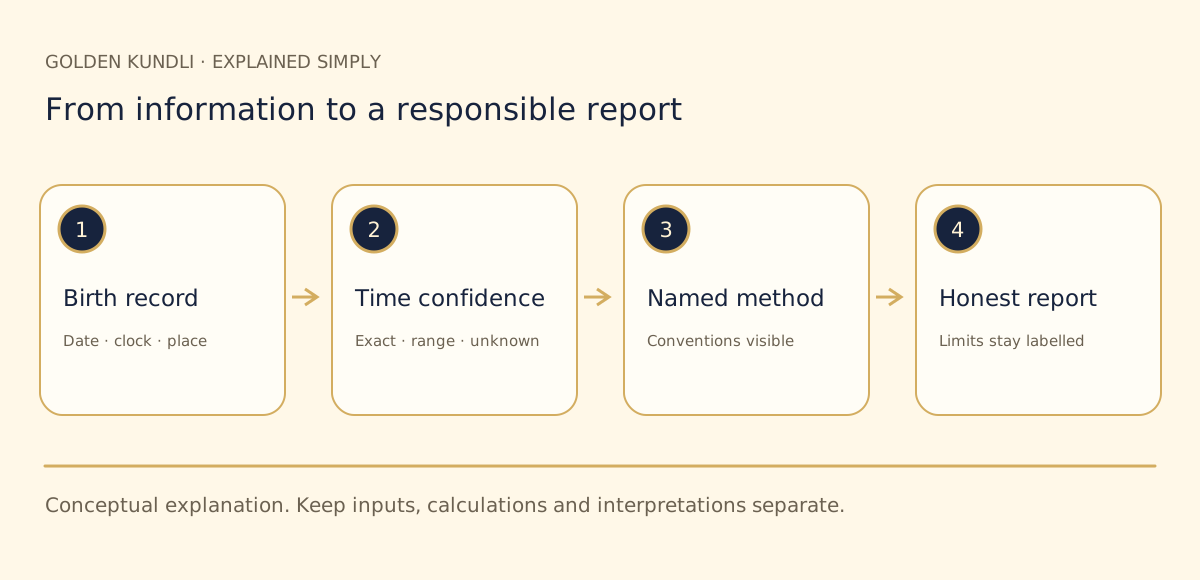
From a birth record to an honest report
Choose any step below. Motion is optional; every explanation stays readable.
1. Find the record
Check the original date, clock time and birthplace. A family memory can help, but should be labelled as a memory.
2. Keep uncertainty
Record an exact time, a remembered range or unknown. Do not quietly turn a guess into an exact minute.
3. Check the method
The calculation needs appropriate historical civil-time handling and clearly stated conventions.
4. Explain the limits
Keep time-dependent sections marked uncertain or unavailable. An assumed input is not a verified fact.
Your device prefers reduced motion. You can still choose every step above.
What a range comparison can and cannot tell you
If your best information is a window, ask for a comparison across that window using consistent settings. This is a sensitivity check: which reported values stay the same, and which change when the input time changes? It is not proof that one point inside the window is the actual birth time. Keep the window visible in the report. A useful comparison identifies the particular result that changes rather than saying vaguely that the entire chart becomes invalid or that nothing matters.
Do not choose a time merely because it produces a preferred description. Suppose a fictional reader has a possible window from 7:00 to 8:00. Three trial charts are calculated at the beginning, midpoint and end. Some fields agree; one important field changes. The honest conclusion is that the changing field is uncertain over the tested window. It is not that 7:30 has been verified because the midpoint is convenient. A more thorough technical review might test additional boundaries, but even that cannot substitute for an independent record of the birth event.
Noon charts need a visible warning
A reference chart calculated for noon can be useful for an explicitly limited comparison, but it should never quietly become your verified profile. The report should say 'Reference time used: noon; actual birth time unknown' wherever time-dependent conclusions are discussed. If a form requires a time and offers no unknown option, ask support how the uncertainty is handled. Do not assume that leaving a default untouched is harmless. Defaults are still inputs, and readers may later forget which fields were estimated.
For example, a fictional family might use noon to check whether a broad date-based astronomical field remains stable across several trial times. They should not then describe the noon chart's houses as established facts. Nor should a report promise an exact wedding date or career milestone based on that placeholder. The important question is not whether the page looks complete; it is whether the conclusion is justified by the information available. A responsible service can say that a requested detail cannot presently be established.
 View full-size illustration ↗
Be careful with birth-time rectification claims
Rectification usually refers to an attempt to infer a birth time by comparing an astrological framework with reported life events. This guide does not establish that such an inference is scientifically reliable. If someone offers the service, ask what method they use, what uncertainty remains and whether the result can be checked against independent information. An exact-looking answer is not sufficient evidence. Be especially cautious if the method changes its assumptions whenever a reported event does not fit.
Keep events you supplied separate from claims generated before you supplied them. If you tell a service that you moved abroad in 2012 and its report later says you moved abroad in 2012, that is a restatement, not an independent discovery. Ask whether the estimated time is a working hypothesis or a verified record. Those are different things. Do not let a hypothesis replace the original 'unknown' label in your family archive. Payment, credentials and confident language do not eliminate the need to explain the evidence and the limits.
Build a one-page input sheet
Create a simple input sheet before ordering any report. It can be a private paper note rather than an online document. Include the subject's name, original date, clock reading, time-quality label, birthplace, current city if relevant, and source notes. Add a separate box for unresolved questions. If a date or place has two plausible interpretations, write both. The goal is to make the uncertainty easy to see, not to make the page look final before the information is ready.
For a fictional reader called Meena, that sheet might say: 'Date copied from certificate; time remembered by mother as shortly after breakfast; possible window not yet agreed; birthplace confirmed; current city Calgary.' No technical result should be invented from this example. It illustrates how to organise a question, not a completed chart. When Meena later finds a hospital note, she can update the source line without losing the history of the earlier estimate. This approach also helps family members understand why two reports prepared at different times may disagree.
Compare reports like a careful reader
Before comparing interpretations, compare their inputs. Are the names, birth dates and locations identical? Is one using an estimated time? Do both disclose the same zodiac and house settings? Are they comparing the same kind of chart? If those details differ, the reports are not yet a fair comparison. Make a small table of the differences, then ask a focused question. 'Why is the time in this report an hour later?' is easier to investigate than 'Why is everything wrong?'
After the inputs agree, distinguish a reproducible calculation from a symbolic interpretation. Two services can agree on a numerical value while using different traditional language around it. Conversely, two soothing descriptions can sound similar while their calculations differ. Do not treat agreement in tone as verification. If a report omits its method, request the missing information. If it cannot provide a calculation field because the time is unknown, that limitation should be visible. Good presentation makes the evidence easier to inspect; it must not hide the assumptions underneath.
A useful report still needs understandable explanations
You should not have to decode a wall of Sanskrit terms to understand what the service has actually established. Each important statement should explain the input it uses, the result it reports and the uncertainty affecting it. A statement such as 'This comparison uses your supplied date and a provisional time range' is more informative than a dramatic claim about destiny. An understandable report can respect cultural vocabulary while explaining it in ordinary English. The reader should be able to tell which sections are educational and which are intended to be personalised.
Do not confuse length with depth. A long report repeating the same reassurance across ten sections may contain little new information. Equally, a concise statement explaining why a field is uncertain can be genuinely useful. If you are considering a paid edition, compare the listed scope, current availability and delivery terms on the product page. Buying more pages should not mean buying stronger certainty than the underlying inputs support. The full edition should expand the promised analysis, not conceal caveats that were visible in the preview.
Sharing family charts without sharing everything
Birth details and personal concerns deserve thoughtful handling. Ask the subject's permission before entering someone else's profile or sending their report to relatives. Share only the section needed for a discussion. A general explanation of a chart term may be safe to forward publicly; a full report containing a person's details is a different matter. Avoid placing certificates or private reports in large community groups just to obtain a quick second opinion. The possibility of a helpful reply does not make every recipient an appropriate recipient.
If you are helping an older parent, read the form aloud and confirm whose report is being prepared. Explain which information is required and which is optional. Do not request a full life story when a narrow question would do. Allow them to stop, edit or decline. Keep downloaded PDFs somewhere they can find again, but avoid shared devices or public links when the document contains private information. These are practical privacy habits, not a promise that any particular app stores information securely without further verification.
Questions worth asking before you continue
Ask the service: 'Can I mark my time as unknown?'; 'What conclusions will you omit?'; 'Can I review the resolved location and time zone?'; and 'Will my estimated details remain labelled as estimated in the PDF?' If you are comparing a range, ask exactly how many inputs were tested and whether the same method was used throughout. If the service offers rectification, ask how the proposed time is distinguished from an independently documented time. Clear answers should not depend on you making a payment first.
You can begin with the free Kundli tool and read our calculation standards before deciding whether a report suits your needs. For the related clock-conversion issue, see our NRI birth-time guide. If your main concern is understanding why D1 and D9 look different, continue to the D1 and D9 reading guide. These routes should help you ask a better question, not make you feel that a missing minute is a personal emergency.
A calmer next step for your family
Set aside a short, manageable period to collect the first source and create the input sheet. You do not need to resolve every uncertainty in one evening. Finish by writing down what changed and what remains unknown. If the evidence is still incomplete, keep the estimate visible and postpone claims that depend on it. The result is a more reliable foundation for any future conversation, whether you continue with Golden Kundli, another service or a family adviser.
The strongest next step is not a confident prediction. It is a clear account of the information you actually possess. That protects you from accidental errors, gives a reviewer something meaningful to inspect and keeps family discussions respectful. A cultural tradition can be approached with care without pretending that uncertainty has disappeared. Start with what is known, make room for what is not, and let any report earn your trust through transparent methods and useful explanations.