
Start with the people, not the score
A marriage discussion can bring together affection, family hopes, religious practice and practical questions about where two people will build their lives. For Indian families living abroad, a Kundli matching report may be part of that discussion. It can also become confusing when one large number appears to speak for everything. A number cannot tell you whether two people listen to each other, whether their plans are compatible or whether they freely want the same relationship. Keep those questions at the centre from the beginning.
This guide explains how to read the familiar 36-Guna format without giving it more authority than it deserves. It also provides a practical way to check inputs, protect both people's privacy and use a report as a conversation aid. It is not a verdict on a couple, a substitute for counselling or a guarantee of marriage outcomes. The examples are fictional and illustrate report-reading habits. No personal matching result has been calculated for the people described here.
 View full-size illustration ↗
What the maximum of 36 actually means
Ashtakoota is an eight-part traditional matching framework. The AstrologyAPI endpoint documentation publishes the component structure and numerical maxima shown below. Spellings vary across reports; recognise the component by its role in the table rather than assuming a changed spelling is a different calculation. These weights describe the scoring framework. They do not establish a measured probability that a relationship will succeed.
| Component | Common alternative spelling | Maximum points |
|---|---|---|
| Varna | Varna | 1 |
| Vashya | Vasya | 2 |
| Tara | Dina | 3 |
| Yoni | Yoni | 4 |
| Graha Maitri | Maitri | 5 |
| Gana | Gan | 6 |
| Bhakoot | Bhakut | 7 |
| Nadi | Nadi | 8 |
| Total | Eight components together | 36 |
The arithmetic is straightforward: one plus two plus three plus four plus five plus six plus seven plus eight equals 36. The difficult part is interpretation. A reader may see a high total and assume every concern has been answered, or see a low total and fear that a disaster has been predicted. Neither follows from the arithmetic. A score should be presented with its method, component breakdown and limitations. A complete explanation must leave room for the actual relationship, not remove it.
A total is not a percentage of happiness
If a report gives 27 out of 36, dividing 27 by 36 gives three quarters. That is a mathematical fraction of the available scoring points. It is not evidence that the couple has a 75 percent chance of being happy. The same distinction applies to any total. A beautifully designed percentage gauge can make a traditional classification look like a measured forecast. Ask what evidence supports the label before accepting that impression.
A useful report can say that a result is a traditional score within a named framework. It should not silently rename it a success rate, emotional-health score or certainty level. There is no reason to make the language frightening to make the report feel important. A calm explanation is stronger because readers can understand what was calculated and what remains unknown. When a service gives a threshold, ask whether it is a convention used by that service or a claim backed by research. Do not confuse the two.
Read the components before discussing the conclusion
The total hides how points are distributed. Two reports can have the same total while showing different component patterns. Looking at the breakdown lets you ask a specific question: which component received this value, which inputs were used and how is the traditional interpretation being described? It does not require you to memorise every rule. It requires the service to make its explanation inspectable.
Begin with the table, then read any narrative. If the narrative speaks about a component that is not displayed, request the supporting output. If the total does not equal the displayed component values, that is an arithmetic or presentation issue to resolve before interpreting anything. If the service uses additional checks, these should be labelled separately. They should not be folded into the same number without explanation. A clear report keeps calculation, traditional interpretation and practical suggestions in different sections.
Explore the idea · at your pace
A matching score is one part of a conversation
Choose any step below. Motion is optional; every explanation stays readable.
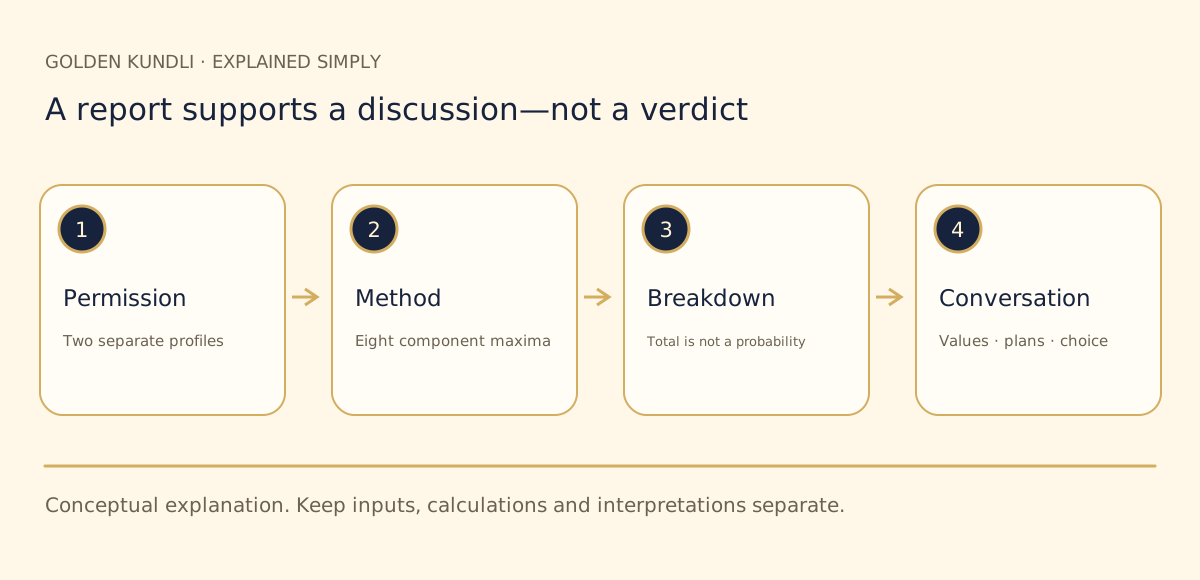
1. Ask permission
Both people should understand and agree to the use of their birth details. Keep two separately labelled profiles.
2. Name the method
Ashtakoota uses eight component maxima: 1, 2, 3, 4, 5, 6, 7 and 8. Together they total 36.
3. Read the breakdown
Inspect the component values and limitations. A fraction of 36 is not a validated chance of marital happiness.
4. Talk in real life
Discuss values, location, responsibilities and expectations. The couple's informed choices remain central.
Your device prefers reduced motion. You can still choose every step above.
Check both profiles before believing the result
One of the simplest mistakes is also one of the most damaging: the service uses the signed-in account owner's details for a report intended for another person. A matching report needs two clearly identified subjects. Before generating it, look for two separate summaries with names or chosen labels, dates, birthplaces and times. After downloading it, check the cover and input page again. A report with the wrong subject is not made reliable by having attractive charts.
Use a plain comparison sheet. Profile A should correspond to one person throughout the form, chart labels, explanatory text and PDF. Profile B should correspond to the other. If you edit one person's details, make sure the other profile has not changed. If the system asks you to select a family member, confirm the selection instead of assuming it has remembered the previous report correctly. These are basic quality checks, but they prevent confusion that no interpretation can repair.
Unknown times should remain unknown
Some families have a recorded birth time; others remember only a broad part of the day. Do not turn an uncertain time into an exact minute to make a form accept it. Ask what the service can responsibly calculate with the available information and what must be omitted or marked uncertain. A placeholder should never be disguised as a verified record. The input summary should make the difference visible to both people.
If one person was born near a date boundary, check the original local date and clock record carefully. If their birthplace is outside India, historical civil-time handling also matters. You do not need to calculate the offset yourself, but you should ask the provider to explain how it resolved the recorded time. The birth-time guide gives a practical record-gathering process. Correcting an input is a reason to regenerate the report; it is not a reason to invent a story about the previous result.
Ask which matching tradition is being used
Not every marriage report follows the same structure. A service may offer Ashtakoota, another traditional method or additional chart interpretations. A familiar heading does not guarantee identical rules. Ask the report to name its framework and describe any extra checks separately. A comparison is meaningful only when you know what you are comparing. Different outputs should not be blended into a single dramatic verdict simply because that is easier to sell.
If your family follows a particular regional practice, state that preference before ordering. If the service cannot support it, an honest answer is better than an improvised approximation. A report may be useful within its stated scope and still not meet every family's expectations. Do not assume that purchasing a more expensive edition automatically adds a method that was never described. Read the contents and availability notes first, including any items planned for a future release.
Treat sensitive labels carefully
Traditional terminology can carry strong emotional associations. A label should not be used to rank a person's worth, intelligence, morality, caste or suitability for respect. Neither person should feel reduced to a component in a scoring table. If a phrase sounds demeaning, ask for a neutral explanation of the method and its limits. The purpose of a family discussion should be understanding, not humiliation.
Likewise, do not turn a chart label into a health or fertility diagnosis. Such concerns require qualified medical advice and cannot be settled by a matching score. Avoid repeating alarming interpretations to relatives as established facts. A sentence copied into a family group can cause more distress than the original report intended. When sharing is appropriate, share the method and the uncertainty along with the result, and obtain the couple's permission before distributing their personal details.
 View full-size illustration ↗
A practical conversation for couples living abroad
After reading a report, put it aside for a moment and ask about daily life. Where does each person expect to live over the next few years? How important is proximity to parents? What happens if one person wants to move and the other wants to remain? These questions are not less meaningful than a chart. They are directly connected to the life the couple is considering together.
Talk about work schedules, languages used at home, religious practice and expectations around children, if relevant. Ask what support each person needs during a stressful period. A calm conversation does not need to become an interrogation. Choose a few topics, give each person time to respond and recognise when an answer needs further discussion. The report can help you begin reflecting, but it should not claim to have already answered questions that only the people themselves can answer.
Money and responsibilities deserve plain words
Discuss how expenses, savings and responsibilities would be handled. Ask what each person considers a shared expense and what they prefer to keep separate. If either supports relatives, has significant commitments or expects a change in work, that belongs in an honest conversation. Do not ask an astrology report to reveal a hidden financial truth. A report cannot replace relevant records or direct disclosure.
This is a planning exercise, not financial or legal advice. If the situation involves contracts, immigration, ownership or complex obligations, seek appropriately qualified help. The useful contribution of a reflective guide is to organise questions in understandable language. It should not issue high-stakes instructions from chart patterns. A couple should be able to say, 'We need to talk about this,' without hearing, 'The chart has decided this for us.' That leaves space for judgement and informed choice.
Families can support without taking over
Parents and relatives may want reassurance, especially when family members live far apart. The kindest role is to help the couple check information, understand options and discuss concerns safely. It is not to use a score as a tool for pressure. Ask the people involved how much of the report they want shared and which discussions they want to lead themselves.
A practical family rule is to avoid forwarding screenshots until the couple has read the complete report and agreed. Another is to avoid declaring a final conclusion from a headline number. When relatives disagree about tradition, separate the disagreement into understandable questions: which method was used, what does the report actually say and what importance does each person want to give it? A respectful process may not remove every disagreement, but it reduces the chance that confusion will be mistaken for certainty.
A fictional example: two households, one decision
Consider Asha and Rohan, fictional adults whose families live in different countries. Asha's mother asks for matching because it is part of the family's marriage custom. Rohan is willing to participate but wants his birth details kept out of large messaging groups. They agree to use separate profiles, confirm the information and read the report together before deciding what to share.
Their most useful conversation turns out to concern location. One expects to remain close to parents; the other anticipates moving for work. No matching result is supplied in this example, because the point is the process, not an invented chart. The report-reading checklist helps them avoid input mistakes. Their direct conversation helps them identify an issue that deserves practical planning. Both can be valuable without pretending that one replaces the other.
What a useful free preview should include
A preview should offer something understandable before asking you to pay. That might include the named matching framework, the confirmed profile summaries, a clearly explained piece of the component output and a short statement of limitations. It should show enough substance to let you assess the quality of the explanation. Several pages of introductions and a blurred score are not the same as a useful preview.
The paid edition should state exactly what it adds: for example, additional component explanations, supported charts, organised discussion prompts or a downloadable complete report. Only features actually available should be offered for purchase. A '30 percent preview' describes access to selected content; it does not mean 30 percent of the truth has been revealed, nor that payment can guarantee the remaining truth. Pricing should be visible, including currency, before the customer decides.
What to inspect in a downloaded PDF
Open the PDF on the device you normally use. Can you read the names, input table and chart legends without extreme zooming? Are component values visible, and does the narrative name the same people? Does a long paragraph continue correctly onto the next page? A report that looks impressive on a wide computer screen may still be difficult to use on a phone or when printed.
Check that the document includes its issue date, method, limitations and a sensible route to support. If a preview contains an upgrade link, it should take you to the relevant report rather than a confusing catalogue. A paid document should be complete within its advertised scope and downloadable after purchase. Keep a copy privately if you need one, and read the service's current storage policy. Do not assume that a report stays in the account forever simply because it was paid for.
When two services give different scores
Do not immediately choose the result you prefer. First compare the two input summaries and method descriptions. Check whether one service used an approximate time, selected the wrong birthplace or labelled a different matching framework. Then ask whether the component values and any additional checks can be compared directly. A difference should be investigated before it becomes a family argument.
Keep both reports unchanged while asking for clarification. Note the version and date so that a revised result can be distinguished from the original. If a provider changes an explanation after you describe your relationship, that change should be labelled as a response to your information, not a fact newly discovered in the chart. A transparent correction is useful. A moving conclusion that always matches the latest story is not a reliable basis for evaluating a service.
Privacy is part of a good matching experience
Birth details belong to the people whose records they describe. Ask permission before entering another person's information, and explain which service will receive it. Use only the information necessary for the requested report. A public link, social card or community message should never include private birth times, full addresses, sensitive concerns or an unprotected report download.
Review the privacy information and check whether guest details are saved, whether a signed-in profile is retained and how deletion works. If you are helping older relatives, show them what will be submitted rather than making decisions invisibly. A supportive service should not need an address book or a phone number simply to explain a matching framework. Marketing choices should be separate from the decision to receive the report.
A five-minute reading routine
Begin by checking the two subjects and inputs. Next, read the method name and component table. Then read the explanation, marking any sentence that sounds like a guaranteed outcome or a diagnosis. Ask for clarification on those sentences rather than accepting them because they appear inside a premium PDF. Finally, discuss one practical topic that matters to the couple.
Keep the routine short enough that it can be used by someone reading on a phone. You do not have to master astrology to ask for accurate labels, honest limitations and a useful explanation. If the report is unclear, pause. There is no obligation to make a decision immediately or to purchase a remedy because of an alarming phrase. The accuracy page explains the distinction between supported calculations and interpretation, and the D1 and D9 guide can help with chart labels.
A calm conclusion
Kundli matching can be approached as a traditional practice without treating its score as a complete description of two people. The strongest report-reading habits are simple: verify both profiles, understand the method, inspect the breakdown, protect privacy and keep the couple's choices central. These habits remain useful whether the family gives the report great importance, modest importance or none at all.
If you choose to explore Golden Kundli reports, read the current availability and contents before selecting a preview or paid edition. Start with clear information, not fear. A marriage deserves room for honest conversation, mutual respect and practical planning. A report is at its most useful when it supports those activities and clearly states where its knowledge ends. It should leave people better informed, not less free to think for themselves.